Showing posts with label book reviews. Show all posts

Thursday, March 17, 2011

Everybody Has Their Own Opinion


No single musician or band has captivated me so completely as once did Los Angeles-based Jane's Addiction, a four-member, semi-dysfunctional freakshow whose music will resonate with me forever.

Between 1987 and 1993, I spent untold sums of money on Jane's Addiction posters, stickers, bootleg recordings, concert tickets, and t-shirts.

In poor imitation of the lead singer, I wore (supremely wretched) dreadlocks in my hair; had my nose pierced in a dicey St. Louis thrift store; and for a short time refused to suffer any criticism of the band from cronies ... or my mother.

And I perpetrated all of this foolishness for a group with just a single self-titled live album and two studio albums--Nothing's Shocking and Ritual de lo Habitual--when Bill Clinton began his first term as President.

To date, they've produced a third (Strays) and a fourth, tentatively called The Great Escape Artist, is reportedly in the works. But I'm not holding my breath ... or even that interested, really.

The band's original line-up consisted of founder and front-man Perry Farrell, bass player Eric Avery, guitarist Dave Navarro, and drummer Stephen Perkins. Tensions with Farrell prompted Avery to leave in 1991, and (with a couple exceptions) he has not expressed interest in returning.

Wikipedia, fan sites, and the official JA site can provide more background, should you be interested.

Alternately, you can read Brendan Mullen's Whores: An Oral Biography of Perry Farrell and Jane's Addiction, which prompted my present nostalgia.

I was fairly well-versed in the band's history and had a good handle on three of the four musicians' heavy drug use.

Interviews with family members and friends from the L.A. music scene filled some important gaps in my knowledge--for instance, Navarro's mother and aunt were murdered by his would-be step-father and it was many years before he was apprehended.

Avery is described by peers as the brainy, brooding dude I intuited him to be. Perkins is a kind of steadfast glue, willing to stick with the rest in good times and bad.

And if Mullen's assembled history is close to the truth, and his contributors forthright, Farrell is an exceptionally charismatic, cocky, and self-obsessed libertine. Perhaps my biggest takeaway is what I'll call the Perry Farrell Paradox.

He has always enjoyed the wild abandon of parties, gathering people together, and is credited for dreaming up Lollapalooza and other music events. In fact, he was willing to lose a considerable amount of his own money investing in concerts (later in his career).

And yet, and yet ... the irony: he is consistently an incorrigible prick averse to equitable contracts and financial arrangements with bandmates.

All of which suggests nothing less than the usual hedonism and heroics of most rock 'n roll stories ... which is why Jane's Addiction so fascinated a particular bucktoothed, introverted high-schooler in south-central Illinois.

Friday, September 24, 2010

When you need an answer ...

Check out the New Books room at the library!

Recently, I have been on a major clean-out binge at home. Closets, cupboards, and cobwebby boxes in the basement have all come under scrutiny.

Naturally, questions arise. For example: What is one to do with those odd pillowcases that don't match anything, given that mix-and-match linens are simply unacceptable in polite society?

Ta da!


Craft Challenge: Dozens of Ways to Repurpose a Pillowcase comes to the rescue! Right there waiting on the new book shelf was the answer: "Liberate pillowcases from humble bedding!" With 28 different projects, my forlorn and neglected pillowcases now have a whole new lease on life.

Repurposing! It's a step above recycling. Let your library show you the way!

Thursday, April 29, 2010

Smile Politely's Stories & Beer

It's a big tease, the Stories & Beer events. At least to me, they are. They're on Tuesday evenings, catty-corner from the library at the Iron Post, while I'm working the reference desk at the library. I like to drink beer and hear stories, but instead I toil.

Lucky for me that they record the stories. Most recently, they video-recorded them. Now I can drink beer in front of my laptop while hearing stories and watching their readers. In all honesty, however, when I watched some of these last night, I was actually eating vegan pudding. Watch this space for my news about my competing, non-Tuesday night Stories & Pudding series.

I'm going to make special note of two of the storytellers, Arley McNeney and Joe Meno, because if you like their stories, you should check out their books.

I know McNeney from the University of Illinois English Department, and while I haven't read her novel, Post, my wife has and she gives it the thumbs up. It's a realistic story, human and humorous, about wheelchair basketball, relationships, and a hip replacement. No, you haven't read anything like this.

I do not know Chicago-area author Meno personally, but his The Boy Detective Fails was one of my favorite books of 2006 [see his other books in our collection]. It's about childhood prodigy, not living up to expectations, and loss, told in a unique, un-chronological way with plenty of humor. I haven't recommended it yet to someone who didn't like it. I'll also note his The Great Perhaps, as it's the one he reads from in the video.

Saturday, November 21, 2009

Between the Stacks


Summer’s over. Next week marks the first day of school all over town. In the world of publishing, that means “perfect beach read” is no longer a winning tag. Publishers take the fall competition for your attention quite seriously – September is blockbuster release month and this year it’s especially spectacular: Anita Diamant, Sara Paretsky, Audrey Niffenegger, E.L. Doctorow, Nicholas Sparks, Jacquelyn Mitchard, Sue Monk Kidd, Margaret Atwood, Diana Gabaldon, and Dan Brown, among others, all have new books scheduled to hit the streets.

Obviously, if libraries and bookstores want to put these titles into the hands of readers on Release Day, they need to know about them ahead of time. Most book suppliers offer an advance-notice service for upcoming “hot” titles based on the size of initial print runs. A substantial first printing indicates not just a publisher’s belief in the potential demand for a book but also, their willingness to put money behind it. Large print runs come with marketing plans to generate “buzz.” Buzz creates reader demand that libraries and bookstores aim to satisfy. They order these titles and display them prominently. Voila! A bestseller is born.

Cynics might view this as a self-fulfilling system. Certainly it is true that without an Oprah nudge, a surprise best-seller is extremely rare. This is strictly a numbers game. Librarians and booksellers may pick and choose from these lists based on their past experience and knowledge of local preferences. But the quality of a particular title is not a consideration. This works both ways, of course – those who automatically regard best-sellers as “trash” are as misguided as those who assume they represent the best in American writing.

So what about all those books published with small print runs and no marketing budget? What about all those “promising debuts” and no-name writers-to-watch? This is where libraries play an increasingly important role because they do buy this type of book, although limited budgets and diverse populations make selection challenging. Every book you see not on the bestseller shelf is an intentional choice made with the assistance of reviews from myriad sources, professional expertise, and strong local awareness. In the world of fiction, a bit of hand-wringing and agonizing are usually thrown in as well.

At a library conference, I once heard Sara Paretsky say that she owed her writing career to librarians. Very few people bought her first V.I. Warshawski mystery. But because it garnered good reviews in professional journals, lots of libraries did--enough so that her publisher was willing to go for a second book. John Grisham and Dan Brown are similarly indebted: A Time to Kill and Angels & Demons both sat on library shelves until their authors’ later efforts hit the big time and transformed them into late-blooming best-sellers.

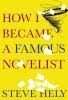
In How I Became a Famous Novelist, Steve Hely’s debut novel, Pete Tarslaw, a cynical young wordsmith, decides to write a best-seller. He wants to be rich and famous, have lots of sex, and humiliate his ex-girlfriend at her wedding. What else can he do? With the New York Times Best Seller list as his guide, he pens The Tornado Ashes Club and sits back to watch his Amazon.com Sales Rank climb.

This is a fast and funny skewering of everything to do with literary America. Writers, publishers, booksellers, reviewers, readers –no one is spared. Merciless, but oddly endearing, laugh-out-loud funny, but thought-provoking, this one might really become a best-seller. Hely is an Emmy-Award-winning television writer, his publisher has sent him on an author tour, and Amazon.com has declared it Best of the Month for July, 2009.

Still, most books won’t. Many well-known, beloved, and prolific authors never do. Many others are quietly awaiting discovery. Librarians and independent booksellers choose their stock carefully to give you an actual choice. You are part of the publishing cycle. Limited choices beget limited choices. Step to the left or right of the best-seller shelf, look below eye-level. Dare to read an unknown author – we chose it for you.

Published in the News-Gazette, August 23, 2009

Tuesday, November 3, 2009

Between the stacks


When The News-Gazette approached me about this column, I thought it was a great idea. I’m a librarian, I love books, and I love connecting people and books. My second and subsequent thoughts have been more measured. The world is awash in book reviews and recommendations. The Urbana Free Library, where I work, subscribes to at least 5 regular book review sources for the reading public. We have databases, websites, C-Span, talk radio, late-night television and the daily email from Amazon. Where does an idiosyncratic column on Stuff I Like fit in here?

In the midst of ruminating, I came across Neil Postman’s comparison of two classic dystopian novels: 1984 by George Orwell and Brave New World by Aldous Huxley. According to Postman, Orwell feared those who would deprive us of information. Huxley feared those who would give us so much that we would be reduced to passivity. Orwell feared we would become a captive culture; Huxley that we would become a trivial one.

I continue to ponder this in terms of publishing and reviews. But, in the meantime, let me tell you that I read Postman’s comments in Chris Hedges’ provocative new book, Empire of Illusion: The End of Literacy and the Triumph of Spectacle. Anything about the state of contemporary America is “political,” but this one is well beyond the usual liberal/conservative exchange. Hedges makes some of the most devastating points through simple descriptive reporting. He starts with the World Wrestling Federation and Jerry Springer--easy enough to see the spectacle there (and to feel smugly above it). But by the end, he’s implicated my Facebook page, my last dinner party, and even the team-building exercise at our staff in-service. It’s a great discussion starter.

Empire of Illusion put me in mind of an old favorite from the 90s: Rosanne Daryl Thomas’ The Angel Carver. This is the story of Jack--a shoe repairman by day, a wood carver by night, who was married for a brief time. One Sunday, his wife walked away, never to be seen or heard from again. Jack has spent 40 years quietly hoping for her return. Instead, Lucille, a star-struck Marilyn Monroe wannabe bursts into his shop and into his life. The blurring of illusion and reality that modern technology permits figures prominently in this novel. A quirky, fun read, The Angel Carver is also a cautionary tale: the technology Thomas invented for her story is commonplace today. What she called the Hell Machine, we call Photoshop.

For more oddball fun, try Jedediah Berry’s delightful debut novel, The Manual of Detection. Here the blurring of illusion and reality is of the funhouse variety. Charles Unwin has worked as a clerk on the 14th floor of Central Agency for 20 years, cataloging the cases of agency star, Detective Travis Sivart. He is content with his lowly place in the bureaucracy; he likes the order and sameness of his days. One morning on the way to work, a stranger approaches Charles, tells him he’s been promoted to detective and hands him The Manual of Detection, suggesting it might someday save his life. Charles believes this is all a mistake, but his attempts to convince others of the mistake soon reveal that mischief is loose in the world. It is indeed up to Charles to save civilization as we know it.

And for those who still have time off ahead of them, check out Pascal Mercier’s Night Train to Lisbon. Fifty-seven-year-old Raimond Gregorius, brilliant but dull, has spent his entire adult life teaching classical languages at a Swiss high school. One morning on the way to work he has a chance encounter with a Portuguese woman. Later, in his favorite used book store, he discovers a Portuguese book, self-published in Lisbon 30 years before. By the end of the day, Raimond has walked out of the school, his job, and his life to board the night train to Lisbon. Somewhat reminiscent of Carlos Ruiz Zafon’s Shadow of the Wind, this is the perfect vacation read. With mystery, romance, and political intrigue, the pages keep turning. Every now and then you’ll feel compelled to look up and out (hopefully over water) while you ponder some of the big ones: Am I in the right place? Is this even the right life? Perhaps this one will be it: the vacation from which you do not come back.

[Published in the News-Gazette, August 9, 2009]