Showing posts with label historical fiction. Show all posts

Monday, July 30, 2012

Wonderland Creek

Wonderland Creek book jacket
We librarians love to read novels about other librarians! My latest find is the enjoyable, charming Wonderland Creek.


The story and the characters are what attracted me to this title. It's inspired by the real life experiences of the packhorse librarians, who during the depression were subsidized by President Roosevelt's WPA (Work Projects Administration) to deliver books to schoolhouses and residents of rural Kentucky.

Alice Grace Ripley, a sheltered young librarian from Blue Island, Illinois, is in a pickle. Her long-time beau, an up-and-comer at his funeral home, dumps her. She always has her nose in a book, and just had to finish that last chapter during the rather boring funeral she attended. How could this be considered disrespectful to poor Mr. Watson? He would have understood--he was a reader and regular library patron. Alice's bad luck continues the next day. Even though she's a dedicated employee, she was the last hired. So, when her library is forced to cut hours, budget and staff, Alice is let go.

What to do? Blue Island is a small town and everyone is surely talking about her two misfortunes. Her father, the local minister, tries to enlist her in one of his projects. There are many in their community needing help during the depression, but Alice is appalled. Unfortunate people make her feel uncomfortable. Instead, Alice plans an alternative task. Inspired by a recent Life magazine article, she's collected 5 boxes of books and 3 bags of magazines for a needy library in the backwoods of Kentucky, and has been in correspondence with Leslie the librarian about them. She'll just deliver the books in person and help catalog them as a volunteer. She can continue with her career, read, and escape a while from the gossip and humiliation she's just faced. Then she'll come home.

But Alice's plans don't occur as expected once she's dropped off in Kentucky by her vacationing aunt and uncle. You'll have to read Wonderland Creek to find out what happens. But rest assured, the book is full of quirky & realistic characters, American history, family feuds, suspense, romance, personal growth & belief, and love for libraries & reading. Alice tells her story in first person, and it's fun to hear this tale through her voice.

Wonderland Creek by Illinois author Lynn Austin was published in 2011 by the well-known Christian publishing firm Bethany House. The author has won a number of Christy Awards, which are presented for excellence in Christian fiction. There is a Christian message in this title, but I feel it is integrated very well and naturally into the plot and personalities of the main characters. This is also a good choice for you if you prefer gentle reads. Discussion questions are included at the end, for book groups.

Wonderland Creek and other books by Lynn Austin are available for you to enjoy at The Urbana Free Library. Place a hold online or contact us librarians at Urbana Free Adult Services.  217-367-4405; reference@tufl.info.

Friday, November 5, 2010

Ancient Feminist Librarian Love Triangle

Adding to my to-watch list, Agora, starring Rachel Weisz as Hypatia, who wants to learn and distribute her knowledge.  She is wanted by her personal slave, Davus, and Orestes, the prefect of Alexandria.  He was also her student.  More complicating facts: She's an atheist, Alexandria is under Christian rule, and it's the sort of Christianity that values wives and mothers more than lady scholars.


Why shouldn't ancient Alexandrians have British accents and epic music?

Check out Ebert's 3 Star review and/or place your request for the library's copy.
blpost

Thursday, September 2, 2010

Follow-ups!

Some new books came in this week, written by authors whose works I've previously enjoyed.  My to-read list grows by four more titles...


I think I'm most looking forward to Ape House, the new book by Water for Elephants author Sara Gruen.  The novel concerns bonobos involved in primate research, and was inspired in part by the author's visit to the Great Ape Trust.  The fictional Great Ape Lab is bombed by activists, and a reporter follows the story, even communicating with the apes via sign language to get their input.


Steven Saylor's Empire also has my interest.  It continues Roma, in which each chapter concerns a member of the Potitii family line in ancient Rome.  These characters are often from different generations with little or no connection to the previous one, but the effect of seeing the blood line's fortunes and travails over time is unique.  Empire takes us further down generations in, according to the cover, Imperial Rome. 


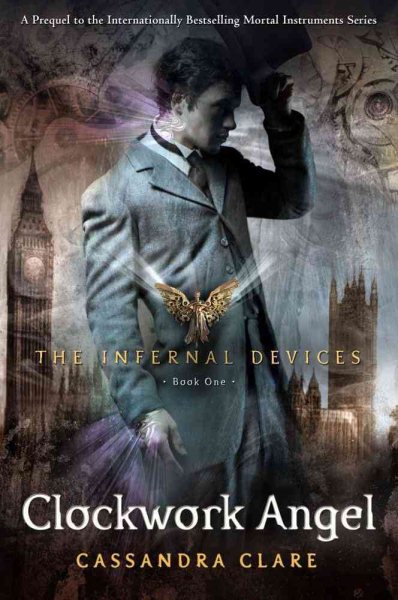
Clockwork Angel begins a new series by Mortal Instruments author Cassandra Clare.  More demons and Shadowhunters await Clare's fans, but this adventure takes place in Victorian-era London, rather than contemporary New York City.


The last is The Elephant's Journey, by the late Nobel-prize winner Jose Saramago.  Saramago drew on historical resources for his fictional tale of an elephant and his keeper traveling from Portugal to Vienna.  They travel along with Archduke Ferdinand and his entourage, as the elephant was a wedding gift to the Archduke from the King of Portugal in 1551.

Thursday, July 22, 2010

Books into Board Games: Ken Follett's Historical Fiction


Ken Follett's Pillars of the Earth was a board game before Oprah chose the book for her book club.  It tells a unique story of...it's hard to describe due to the amount of depth in the story.  If the struggle between nobles and clergy during the building of a cathedral in England is the core of the story, there's still a bit of back story, but it's all interesting.  It's a tome of a book, so I'll understand if you don't take my word that it's worth your time.  If you have cable, you can sample the story this Friday, when Stars airs the first of its eight-part Pillars of the Earth miniseries.

Photo from BoardGameGeek user Artax

Anyhow, I've gotten off track--Pillars and it's sequel World Without End have inspired some good games.  I'm a fan of the The Pillars of the Earth board game, which has the unique round-counting tool of a cathedral under construction.  After six rounds, the cathedral is built, and whoever has the most points wins. Mechanics-wise, Pillars is a worker placement game, where each player has the opportunity to place their workers on sometimes limited numbers of spots, earning either a bonus for themselves or the optimal number of resources to convert to victory points on their turn.  Listen, the game is as hard to describe as the book--it's complex and economically challenging.  I'd rather recommend someone else to explain the game to you--I'll link to librarian/gamer/professor Scott Nicholson's video review at the end of this post.


The World Without End boardgame was published this year and it received a Spiel des Jahres Plus award.  The Spiel des Jahres, or German Game of the Year, is the closest thing to the Oscars for boardgames, and the Plus is a special honor given to a game each year.  I didn't get to play World Without End on my recent Origins trip, but my friends picked up a copy, which suggests that they liked it, although they have something of a board game habit, if you get me.  As I'm completely unfamiliar with World Without End, having neither read that 1000-plus page brick of a book nor played the game, I'll also recommend someone else to tell you about the game--this time, a video review from prolific game reviewer Tom Vasel.

Photo by BGG user Base the Bass

Even if you're not (or not yet) a fan of Follett's historical fiction, these games will appeal to you if you've enjoyed other economic strategy games. 

I'm trying something new today.  I recently read that hyperlinks may be distracting when placed in the text of a blog post, so I'm putting them all below.  Hopefully, this made the post easier to read, and if anything really grabbed your interest, you should be able to find a useful link below.

Check out The Pillars of the Earth from the library:
Book on CD
Hardcover
Paperback

IMDb page for The Pillars of the Earth Miniseries

BoardGameGeek page for The Pillars of the Earth game
Scott Nicholson's Video Review of The Pillars of the Earth

Check out World Without End from the library:
Book on CD
Hardcover

Wikipedia page for the Spiel des Jahres award

BoardGameGeek page for the World Without End game
Tom Vasel's Video Review of World Without End

Wednesday, September 16, 2009

The American Impulse for Violence


Local author and UI faculty member John Griswold has published a gritty, fictionalized account of the Herrin Massacre of 1922, titled A Democracy of Ghosts.

In June of that year, a miner's strike in southern Illinois flared into a conflict that left 19 strikebreakers and two miners dead.

Having studied the historic record, Griswold artfully re-imagines the tensions between union laborers and the "scabs" sent by business owners to replace them. The barbaric outcome horrified the nation.

If historical fiction, state history, or true crime interest you, take a look at these other titles ...

Bloody Williamson: A Chapter in American Lawlessness
Paul M. Angle (Univ. of Illinois Press, 1992)

The Bootlegger: A Story of Small-Town America
John E. Hallwas (Univ. of Illinois Press, 1999)

Brothers Notorious: The Sheltons: Southern Illinois' Legendary Gangsters
Taylor Pensoneau (Downstate Publications, 2002)

Dime Novel Desperadoes: The Notorious Maxwell Brothers
John E. Hallwas (Univ. of Illinois Press, 2008)

A Knight of Another Sort: Prohibition Days and Charlie Birger
Gary DeNeal (Southern Illinois Univ. Press, 1998)

Murder in Little Egypt
Darcy O'Brien (Carroll & Graf, 2002)

The Outlaws of Cave-in-Rock
Otto A. Rothbert (Southern Illinois Univ. Press, 1996)

Tuesday, January 20, 2009

Alys Clare's Hawkenlye series


Alys Clare writes historically accurate mysteries set in 12th century England. Centered around Hawkenlye Abbey, the action always involves the brilliant abbess, Helewise, and a king's knight, Josse d'Acquin. The first title in the series, Fortune Like the Moon, is a great introduction to the period and the entire series. A young nun is found murdered just outside the abbey walls. The queen, Eleanor of Aquitaine, has just released felons from prison to gain acceptance for her son, the new king Richard Plantagenet, so the local people think one of them is the murderer -- but Abbess Helewise and Josse d'Acquin find many clues that lead them to believe otherwise. The English countryside is vividly described, and Josse and Helewise are fresh, charming, and appealing detectives. For a look at 1186 England, I highly recommend Alys Clare's Hawkenlye mystery series.

Saturday, June 28, 2008

The 'Dark Fire' of 1540


Matthew Shardlake is a lawyer in 1540's London who, because of his ethics and honesty, is entrusted with many politically sensitive cases that involve Henry VIII and his advisors, especially the work he does for Oliver Cromwell. Of the 4 mysteries in this series, Dark Fire is the 2nd. Matthew has to solve whether a young girl murdered her 1st cousin or not and also find a lost cache of 'dark fire,' a weapon that could destroy England's navy. Tudor England is brought to life in wonderful period detail in all of C.J. Sansom's excellent historical mystery series. She does, however, take liberty with a few historical facts -- mainly in my opinion to make it a little more gruesome (Oliver Cromwell actually died of malaria, not a botched, painful beheading). Except for that one detail, I found Dark Fire to be an excellent read. The other titles in the series are Dissolution, Sovereign, and Revelation.