Last fall, the Common Ground Food Coop approached the library about collaborating on a bibliography featuring library materials and local resources on the theme of local food [1]. This, we thought immediately, was a very good idea.
The Coop had a fantastic collection of information on state and local organizations, and we had a good collection of books and videos. We just needed to pare things down a bit to fit on an 11 x 17 sheet of paper and some nice local foodsy pics. You know makes a local foods bibliography look good? Photos of the Urbana Market at the Square taken by Lisa Braltz Kelly [2].
So, what's in the bibliography? As I mentioned on WCFN's Page Turners segment on Tuesday morning, the guide is broken up into a few sections [3]. The first section includes books on the issues--why we care whether food is produced locally or from industrial food production. These books approach the issues (including issues of health, environment, employment, and local economies, for example) from both broad and narrow scopes, and range from personal stories to more scholarly sorts of works. There's even a book in this part of the list that disagrees with locavores, in case you're curious why anyone would argue with such level headed reasoning (stubborn devotion to theoretical free market economics).
The second section includes books for those of you who want to be more proactive in supporting local foods. These books get very local, like the beginner gardening books to help you grow food in your back yard or your apartment patio. This level of local just scales up from there--you can raise chickens or cattle, keep bees, make your own yogurt, start your own farm, and sell your produce at the farmers' market.
Want to leave the dirty work to the farmers' already working Central Illinois? That's fine. You might be interested in the books on community supported agriculture (CSA), budget-conscious local eating, or preserving or cooking food you got at the farmers' market.
The last part of the bibliography is the best because it provides information and links to a selection of state and local organizations through whom you can get involved in the local foods movement, learn to grow and raise your own food, rent land and actually grow your own food, and buy locally produced food.
You can get your own copy of the Local Food Resources guide at The Urbana Free Library or the Common Ground Food Coop. You can also find the guide on the library's website [4]. Happy learning/growing/eating!
Freshly harvested local links:
1. The Common Ground Food Coop's site has location info, hours, and information on their highly popular classes and events.
2. Urbana Market at the Square's Flickr stream
3. You can see the video of me talking with Anne Dill (Part 1 | Part 2) on PageTurners at Illinoishomepage.net.
4. Check out the online Local Food Resources guide
Showing posts with label Gardening. Show all posts
Saturday, February 12, 2011
Local Food Resources Guide
Labels:
Bibliographies,
Cooking,
Food,
Food Industry,
Gardening
Saturday, April 17, 2010
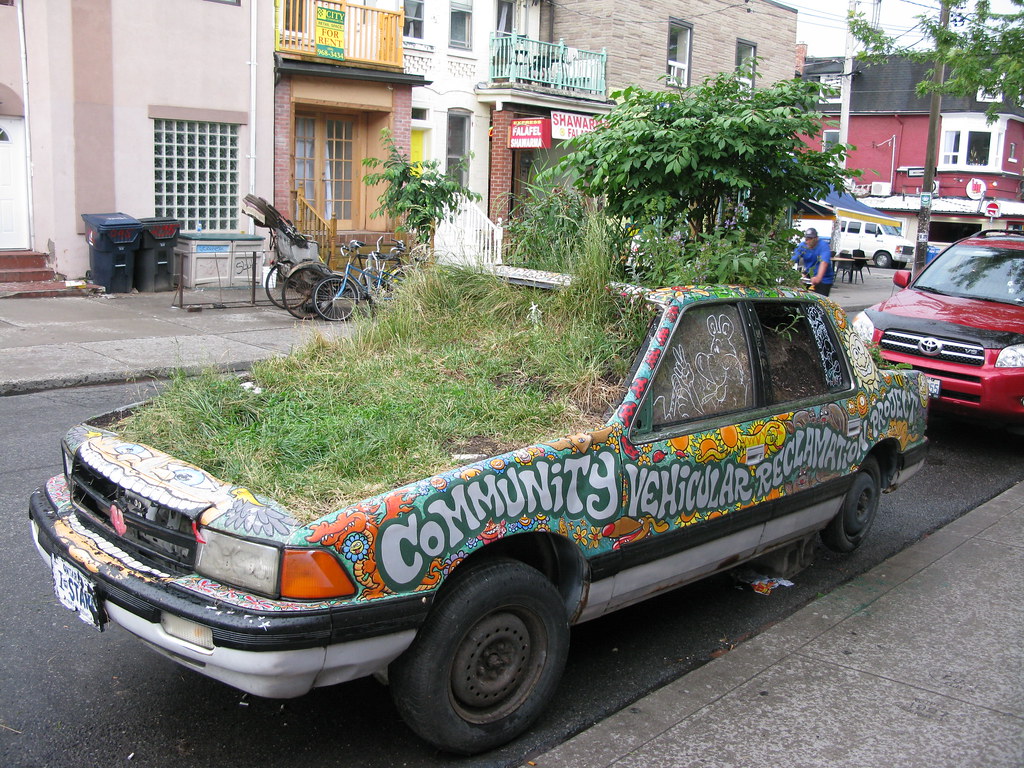
Guerrilla Gardening
According to the Smile Politely post, guerrillas have positioned themselves inside Champaign-Urbana. Lucky for us, they're guerrilla gardeners.
What's a guerrilla gardener? I don't care for the wikipedia definition, as it attaches meaning to the actions of guerrilla gardeners, labeling them as activists, environmentalists, and squatters, when they could just be committing random acts of horticulture. Defining them solely by action, guerrilla gardeners are folks who grow plants on land they do not own without permission.
So, if you've got a plot in the community garden at Meadowbook Park, you're not a guerrilla gardener, but if you plant in an abandoned neighborhood lot, you are.
Intrigued? We've got a book you can check out, called On Guerrilla Gardening: A Handbook for Gardening without Boundaries if you'd like more information.
What's a guerrilla gardener? I don't care for the wikipedia definition, as it attaches meaning to the actions of guerrilla gardeners, labeling them as activists, environmentalists, and squatters, when they could just be committing random acts of horticulture. Defining them solely by action, guerrilla gardeners are folks who grow plants on land they do not own without permission.
So, if you've got a plot in the community garden at Meadowbook Park, you're not a guerrilla gardener, but if you plant in an abandoned neighborhood lot, you are.
Intrigued? We've got a book you can check out, called On Guerrilla Gardening: A Handbook for Gardening without Boundaries if you'd like more information.
Saturday, March 7, 2009
Perennials 101

The Urbana Free Library has an outstanding gardening collection. Some of our best books are published by Timber Press, which we purchase with zeal -- owning over 240 titles. Their publications, and therefore our collection, are especially strong on perennials. The latest, Perennials for Midwestern Gardens by Anthony W. Kahtz, covers 400 plants. Of those, 140 are in detail with an additional 260 recommendations. The book covers perennials, herbs, ornamental grasses, and bulbs. Because of its specificity to the Midwest, every entry is suitable for an Urbana garden.

The Well-Tended Perennial Garden by Tracy DiSabato-Aust includes hundreds of planting and pruning techniques to keep your garden looking fresh. One nice facet of this books is the listings of related plants -- those plants that would complement the garden by being placed next to each other. She stresses not only color but also form and texture of the leaves.
Joseph Hudak's Gardening with Perennials Month by Month gives ideas that make for an interesting garden from March through September. Some of the useful plant lists are perennials that bloom for 6 weeks or more, those with attractive foliage, and those that are drought tolerant.
The Explorer's Garden by Daniel J. Hinkley covers rare and unusual perennials that have been found throughout the world and would be a unique, yet attractive, addition to most Midwestern gardens. While some of the included plants would not do well in zone 5, I still enjoyed reading about their discovery. Hinkley writes with such exuberance that any reader of his work will want either to garden or to travel, if not both!The last book is Hardy Perennials by Graham Rice. A well-known author (Encyclopedia of Perennials, Discovering Annuals, Plants for Problem Places, etc.), Rice makes season-by-season selections, provides ideas how to grow them successfully, and how to use them imaginatively in the garden.The call number for all perennials is 635.932, although some of the specialty books (poppies, hardy geraniums, etc.) have slightly different numbers, so check the on-line catalog or feel free to ask any of your friendly reference librarians. We're here to help with any question!
Subscribe to:
Posts (Atom)